Antibiotic Resistance & Uptake
We were first acknowledged for our research on the structures and functions of the outer membranes of Gram-negative bacteria, with particular emphasis on the opportunistic pathogen Pseudomonas aeruginosa.
Our work on outer membrane macromolecules led to further contributions concerning two fundamentally important aspects of how antibiotics interact with bacteria. The first arose from our early studies of how polycationic aminoglycoside and polymyxin antibiotics interacted with and cross the outer membrane, and resulted in the Self Promoted Uptake hypothesis. This led us to the field of cationic host defence (antimicrobial) peptides. A second aspect of our outer membrane research related to studies on outer membrane permeability and particularly the role of pore-forming proteins (porins) in transporting substrates across the outer membrane.
An important tool for investigating cellular physiology is next generation RNA-Seq that reveals global changes in gene expression in response to environmental changes and thus is well suited to providing a detailed picture of bacterial responses to antibiotic treatment. These responses are represented by patterns of co-regulated genes termed gene expression signatures, which provide insights into the mechanism of action of antibiotics as well as the general physiological responses of bacteria to antibiotic-related stresses. The complexity of such profiles is challenging the notion that antibiotics act on single targets and are consistent with the concept that there are multiple targets coupled with common stress responses. A more detailed knowledge of how known antibiotics act and induce adaptive resistance should reveal new strategies for antimicrobial drug discovery.
Our work on two component regulators, particularly those involved in polymyxin/cationic peptide resistance, led us to defining important mechanisms of resistance to these agents in Pseudomonas aeruginosa and Acinetobacter baumannii. The fact that these two component systems are regulated by extracellular cues (including often the antibiotics themselves) has led us to pursue the area of adaptive resistance.
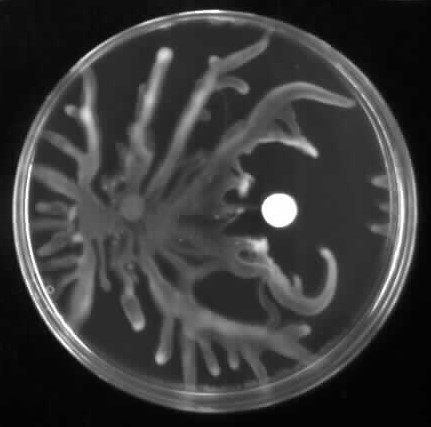
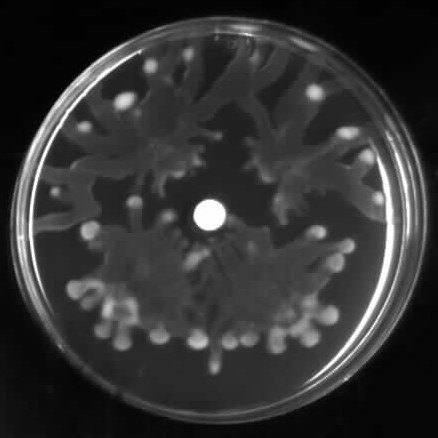
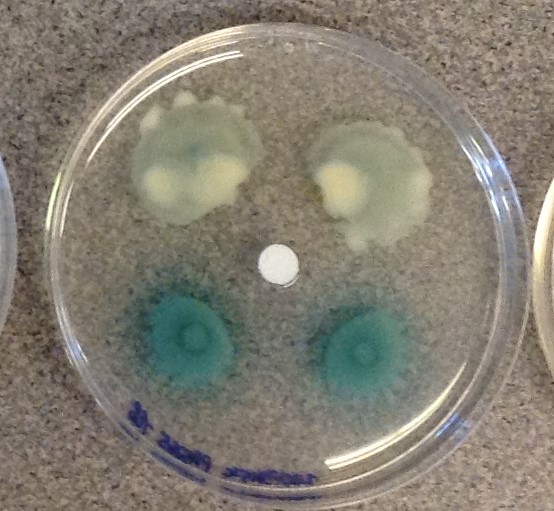
Assessing the antibiotic resistance effects of complex adaptations in swarming wild type and mutant Pseudomonas (based on how closely cells approach the antibiotic disc).
Adaptive resistance
One poorly defined area of antibiotic resistance is adaptive resistance, which describes the transient, reversible resistance to one or more antimicrobial agents in response to the presence of a specific environmental signal. These signals can include particular stresses, including sub-inhibitory antibiotics, and growth states, such as swarming, swimming and biofilm formation. It is particularly prominent in the case of Pseudomonas aeruginosa in which the susceptibility of this organism to antibiotics rarely reflects in vitro susceptibility. We are attempting to understand this phenomenon using the three available Pseudomonas mutant libraries, Tn-Seq, and RNA-Seq and are applying this to the study of adaptive resistance to many antibiotics including ciprofloxacin, aminoglycosides, polymyxins, β-lactams and multidrug resistance. Generally speaking, results to date show that Pseudomonas aeruginosa has evolved complex interwoven regulatory mechanisms that permit adaptation to a wide variety of circumstances and environments (including antibiotic stress and particular growth states). Thus adaptive resistance is usually not a single gene/protein phenomenon but rather involves the induction/repression of large subsets of genes to tailors lifestyle and metabolic capabilities, often leading to resistance and virulence. Currently we are addressing in detail the multi-drug resistance that accompanies the diverse adaptive lifestyles biofilm formation and swarming and surfing motility.